“There is a time for many words, and there is also a time for sleep.”
– Homer, The Odyssey
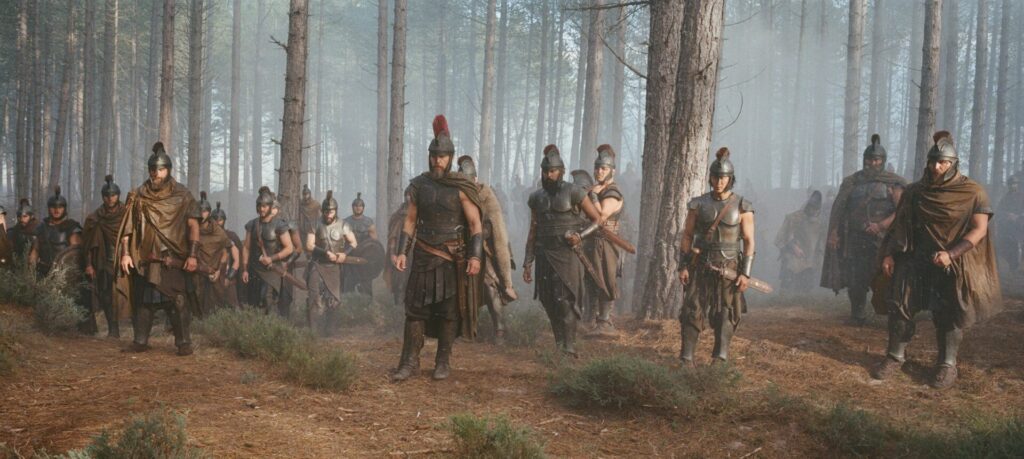
On the surface, The Odyssey is one of history’s greatest adventure stories. A king survives monsters, storms, temptations, and shipwrecks in a desperate attempt to return home after the Trojan War. Christopher Nolan’s adaptation captures the scale of that journey with breathtaking spectacle, but beneath the battles and mythology lies a quieter, more universal story.
Odysseus (played by Matt Damon) is trying to go home. Not simply to a place, but to a life that no longer exists.
When he finally reaches Ithaca, twenty years have passed since he left for Troy. His son Telemachus (Tom Holland) has grown into a man. His kingdom has changed. Even those closest to him struggle to recognize him. Most importantly, Odysseus himself has been transformed by everything he has endured.
It raises a question that extends far beyond ancient Greece. After hardship, failure, grief, or years spent chasing success, can we ever truly return to the person we once were?
Home is never exactly where you left it
Many people imagine that happiness lies in “getting back” to an earlier version of life. Back to the confidence they once had. Back to the relationship before it became complicated. Back to the person they were before burnout, disappointment, illness, or loss.
Yet Homer quietly reminds us that time only moves in one direction.
Odysseus does not return to the same Ithaca he left behind because twenty years have changed everything. The island remains, but the people have aged. His palace has been overrun by opportunistic suitors. His son, Telemachus, barely remembers his father. Even his loyal dog, Argos, recognizes him only moments before dying—a heartbreaking reminder that life has continued without him.
The lesson is subtle but profound. The goal cannot be to reclaim the past. The past is gone. The challenge is to build a future with the person you have become.
Every challenge leaves a mark
Modern psychology increasingly recognizes what ancient storytellers understood intuitively: major experiences reshape us.
Psychologist Richard Tedeschi, who helped develop the theory of post-traumatic growth, found that many people emerge from adversity with greater resilience, deeper appreciation for life, and stronger personal values. Hardship does not automatically make us stronger, but it almost always changes us.
The same transformation is visible throughout The Odyssey.
The confident warrior who left for Troy relies primarily on courage and strength. The man who returns to Ithaca has become something different. He survives not because he is the strongest person in every room, but because he has learned patience, restraint, humility, and strategy. Again and again, Homer rewards wisdom over force.
Odysseus escapes the Cyclops through cleverness rather than combat. He resists impossible odds through endurance rather than aggression. Even upon reaching Ithaca, he does not immediately reclaim his throne. Guided by Athena, he observes, plans, disguises himself, and waits for the right moment.
He has learned that maturity often means knowing when not to fight.
Identity is forged through the journey
One of the most striking moments in Nolan’s adaptation is not a battle but the quiet realization that home cannot simply erase everything that happened along the way. The emotional weight of the film comes from watching a man confront the distance between who he remembers being and who he has become.
This reflects one of the oldest themes in literature. The journey was never simply about reaching Ithaca. The journey was creating the person capable of ruling it.
We often think of identity as something fixed—as if our “real self” is waiting somewhere beneath stress and responsibility. Yet philosopher Heraclitus famously observed that no one steps into the same river twice, because both the river and the person have changed.
Confidence works the same way.
Many people spend years trying to “get their old confidence back.” But perhaps that is the wrong objective. The confident student cannot solve the problems of adulthood. The fearless teenager has not yet developed the wisdom earned through failure. Every stage of life demands a different version of courage.
Growth requires letting previous identities go.
Stop chasing your old self
This is one of the greatest traps in personal development.
People compare themselves to a previous version of who they were. They remember being more motivated, more disciplined, more optimistic, or more social. They view every difficult season as evidence that they have somehow become worse.
But what if the goal isn’t recovery? What if the goal is integration?
The Stoic philosopher Marcus Aurelius repeatedly reminded himself that life is constant change. Fighting reality only creates unnecessary suffering. The better question is not, How do I become who I used to be? but Who does this version of me need to become now?




That shift changes everything. Instead of mourning lost confidence, you begin developing wiser confidence. Instead of longing for easier circumstances, you become capable of handling harder ones. Instead of measuring yourself against the past, you prepare yourself for the future.
The Ithaca Exercise
The ancient poet Constantine P. Cavafy, inspired by Homer’s epic, wrote, “Hope your road is a long one, full of adventure, full of discovery.” His point was that Ithaca gives us direction, but the real gift is who we become along the way.
Take a few minutes to reflect on your own journey.
- Identify the version of yourself you’re still trying to return to. What period of your life do you romanticize, and why?
- List three qualities that hardship has taught you. They might be patience, resilience, empathy, discipline, or perspective.
- Ask what your present season requires. Rather than wishing for your old strengths, consider which new ones your current challenges demand.
- Choose one action that reflects the person you’re becoming. Identity is reinforced through repeated decisions, not grand declarations.
Your Ithaca is still ahead
At the end of The Odyssey, the story is not simply about a king reclaiming his throne.
It is about a man discovering that the destination was never enough on its own. The years of struggle, uncertainty, temptation, sacrifice, and endurance had changed him forever. Returning home did not erase those experiences. It gave them meaning.
Our own lives follow a similar pattern. There are seasons when we feel lost, disconnected from the person we once were, and uncertain whether we will ever feel like ourselves again. It is tempting to believe that fulfillment lies somewhere behind us—that if only we could return to an earlier version of life, everything would be right.
But life does not ask us to become who we were. It asks us to become who our experiences have prepared us to be.
Perhaps that is the deepest lesson of The Odyssey. The hero does not truly return home because he has found his old self. He returns because, after everything he has endured, he is finally ready to become someone new.